Your Daily Rhythm and Your Brain: What a New Study Suggests
We often imagine brain health as something complicated — a long list of supplements, puzzles and rules. But one of the kindest and simplest things you can do for your brain might be something you already half-know: keeping a steady daily rhythm. A large new study adds some gentle weight to that idea.
If your routine tends to drift — especially in summer, with long evenings, travel and visiting grandchildren — this is worth a few calm minutes.
The study, in plain language
Researchers at UT Southwestern Medical Center, led by Wendy Wang, followed 2,183 adults with an average age of 79. None of them had dementia when the study began, and their findings were published in late 2025 in the journal Neurology.
Each person wore a small monitor for about 12 days so the team could measure their natural rest-and-activity rhythm — how clearly their bodies separated busy daytime hours from restful nighttime ones. The participants were then followed for around three years.
The pattern that emerged was striking. People with stronger, more regular daily rhythms were less likely to develop dementia than those whose rhythms were weaker and more fragmented. Among the steadiest group, 31 of 728 people developed dementia; among the least steady, it was 106 of 727. Those whose activity tended to peak later in the day also showed a somewhat higher risk.
One thing to hold onto, though: the researchers are clear that this is a link, not proof of cause. A steady rhythm may be good for the brain, or early brain changes may quietly disturb our rhythms — or, most likely, a bit of both.
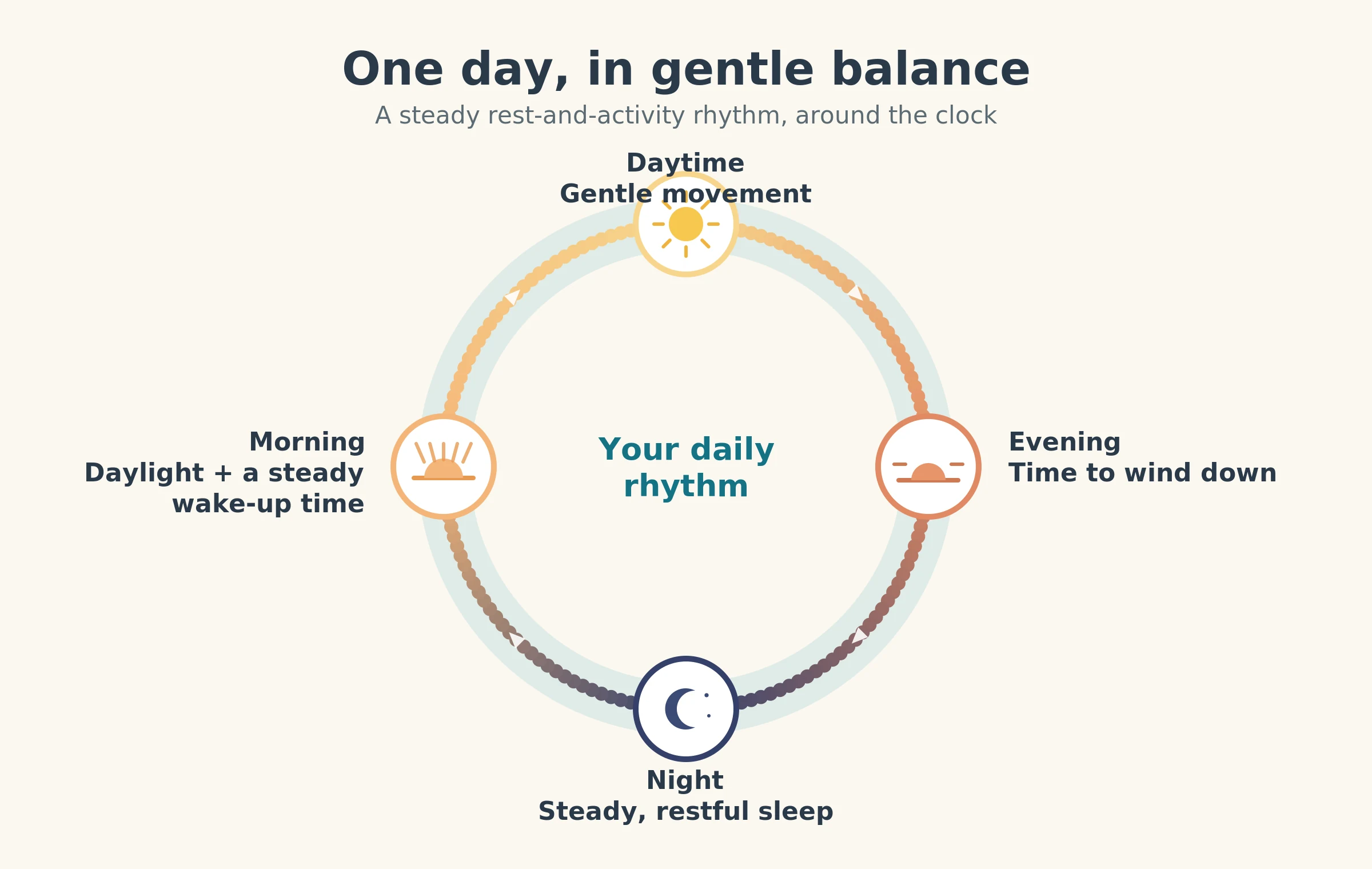
Why your rhythm might matter
Your body runs on an internal clock — the circadian rhythm — that helps line up sleep, energy, appetite and alertness with the natural cycle of light and dark. When that clock is strong, your sleep and activity stay fairly consistent from day to day. When it weakens, the same daily disruptions knock you off course more easily.
The researchers suggest that disrupted rhythms might affect the brain in several ways, including through poorer sleep and higher inflammation. They were careful to call for more research — including studies on whether daylight and lifestyle habits could help — rather than overstating what one study can show. It is an encouraging signpost, not a finished map.
What a steady rhythm can look like
The reassuring part is that a steadier rhythm is built from small, ordinary habits — not a dramatic overhaul. A few that line up with the research:
- Wake up around the same time most days, weekends included.
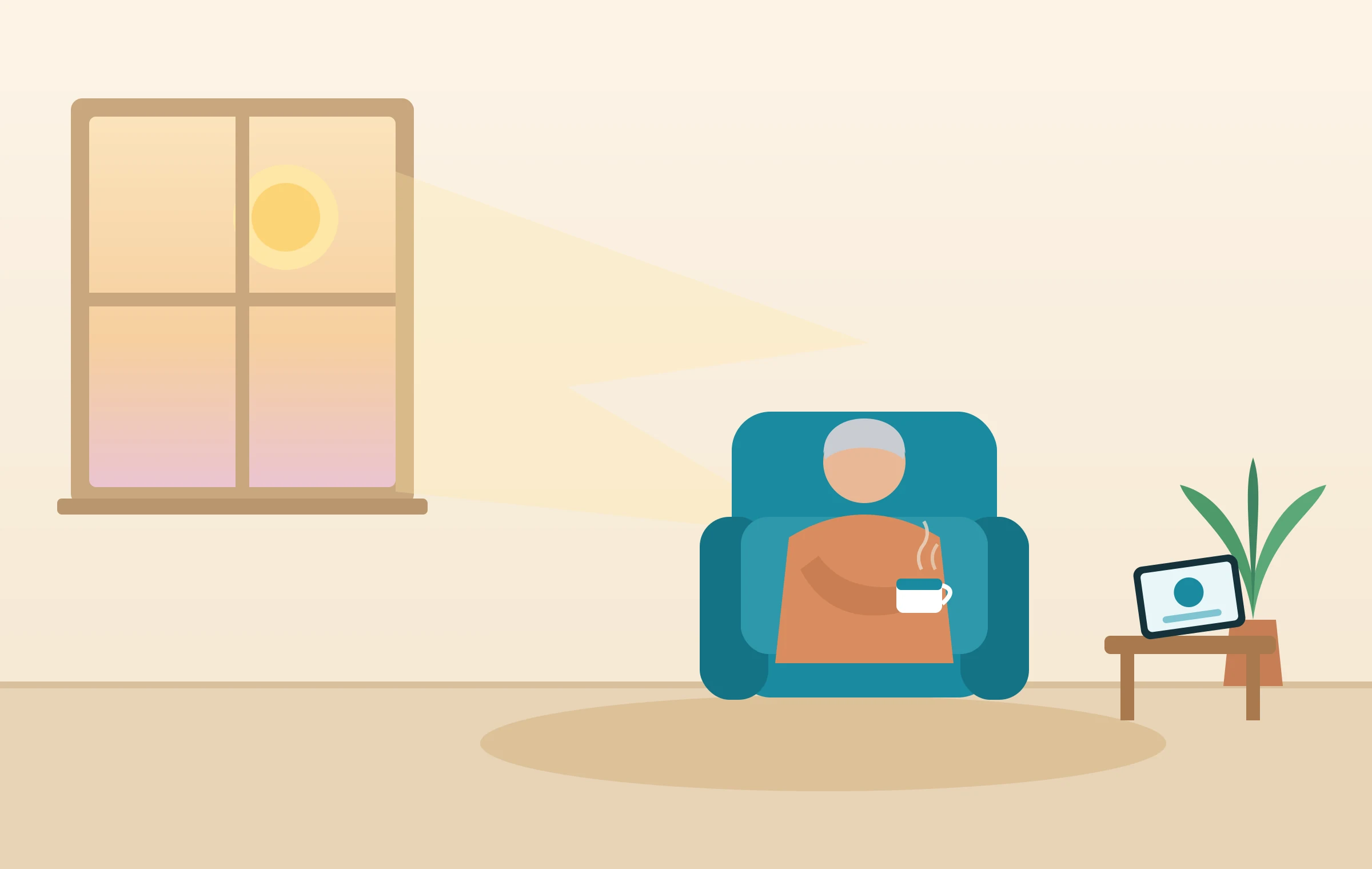
- Let some daylight in early — open the curtains, or step outside for a few minutes.
- Move your body gently during the day, in whatever way feels good.
- Wind down in the evening, dimming bright screens and lights as it gets late.
- Give your day one calm anchor — a quiet moment you return to at roughly the same time.
The thread running through all of it isn't intensity. It's gentle consistency: a rhythm your body can settle into.
An honest caveat
One study, however large and careful, is never the final word. This research shows an association between steadier daily rhythms and lower dementia risk; it does not prove that one causes the other. And it does not show that any habit, app or activity prevents or cures dementia or any other disease. Please treat this as encouraging evidence that your daily routine matters — not as a medical promise. None of this is medical advice, and if you have specific concerns about your memory or sleep, your doctor is the right person to talk to.
A gentle place to start
If there is one comforting lesson here, it is that a calm, repeatable routine may do more for you than any single heroic effort. And a routine is much easier to keep when it has a small anchor you actually look forward to.
That is one of the quiet ways Treeny can fit into your day: a few gentle minutes of brain training, designed for adults over 50, at the same easy time you choose — with a coach named Flo to keep you company if you'd like. Treeny won't fix your sleep or prevent any illness, and it doesn't pretend to. It's simply one small, steady part of a daily rhythm that already belongs to you. There's a free assessment to show you where you stand today, and no card is needed to begin.
Your brain isn't asking for perfection. A gentle, familiar rhythm is something good you can offer it — starting today.
Sources
- ScienceDaily — "A weak body clock may be an early warning for dementia" (3 January 2026)
- Wang, W. et al., "Association Between Circadian Rest-Activity Rhythms and Incident Dementia in Older Adults," Neurology, 2026; 106(2). DOI: 10.1212/WNL.0000000000214513
This article is for general information and is not medical advice. If you have specific concerns about your memory, sleep or thinking, please speak with your doctor.
Share
Something on your mind after reading this?
I'm Marc. I built Treeny and I read and answer every email myself.
Ready to meet Flo?
Start the free assessment, or jump into the 3-minute Meet Flo flow. Both are free, neither asks for a card.
Related Articles
Does Helping Others Slow Cognitive Decline? What a Large Study of Older Adults Found
Does helping others slow memory decline? A study of nearly 18,000 older adults found a link, strongest in those at higher genetic risk.
Does the Flu Shot Lower Dementia Risk? What a Study of 165,000 Older Adults Found
Does the flu shot lower dementia risk? A study of 165,000 adults aged 65+ links the high-dose vaccine to slightly fewer Alzheimer's diagnoses.
Optimism and the Ageing Brain: What a 14-Year Study Suggests
A study that followed more than 9,000 older adults for up to 14 years found that people with a more optimistic outlook had a lower risk of dementia. It shows an association, not proof, but it adds a hopeful note about the way we look at the days ahead.